The Remarkable Trees of Paris and Versailles, France
In 2016 Louise was invited by the L’Association ARBRES (Arbres Remarquables: Bilan, Recherche, Etudes et Sauvegarde), the Association for Trees in France, to produce a body of work that represents the importance of ‘Les Arbres Remarquable de Paris’ (The Remarkable Trees of Paris). For 20 years the association ARBRES has travelled across France to research her legendary Trees. Their aim has been to raise awareness and publicise these Trees in order to protect them.
The Mairie de Paris categorises trees as ‘Remarkable Trees’ by their age, uniqueness, morphology, identity or social role. These trees can be found on their database.
The project required permission to photograph at night in parks, sometimes after midnight, during the parks’ official public closing times.
This led to interest from the Palace of Versailles and in 2017 Louise gained permission to photograph at night in the gardens of Marie Antoinette and within the Arboretum de Versailles-Chevreloup.
These events led to an invitation from the Museum National d’ Histoire Naturelle in France in 2018 to produce a solo exhibition of the resultant work .
The exhibition, PORTRAITS D’ARBRES REMARQUABLES ILLUMINÉS or Portraits of Remarkable Trees, Illuminated honours some of the Remarkable Trees of France and includes images taken in the Jardin des Plants, the Jardin des Tuileries, the Park of Petit Trianon Versailles and the Arboretum Versailles-Chèvreloup.
Selected artworks from this collection were exhibited at Portraits of Extraordinary Trees, Illuminated, 2020, Royal Botanic Garden, Sydney (Calyx)) with Significant Trees of the Royal Botanic Gardens, Sydney.

Le micocoulier or Hackberry (Celtis australis) is a deciduous Mediterranean tree in the Cannabaceae family. It can easily live up to 500 years old. The leaves of this tree have medicinal properties. For ancient peoples, hackberry was a sacred tree. The priestesses offered their branches, which they had cut as an offering (for example the hackberry near the temple of Diana in Rome). The funeral urns were made from the wood of its roots. The Gauls believed that this tree offered eternal strength. In Occitan, le micocoulier is called “fanabreguier” or temple tree. The suffix “bréguier” refers to “brogilum”, a Gallic word meaning wood of sacred trees. Sculpture in foreground: ‘The death of Lais’. Mathieu-Meusnier Roland. Marble, 1850.
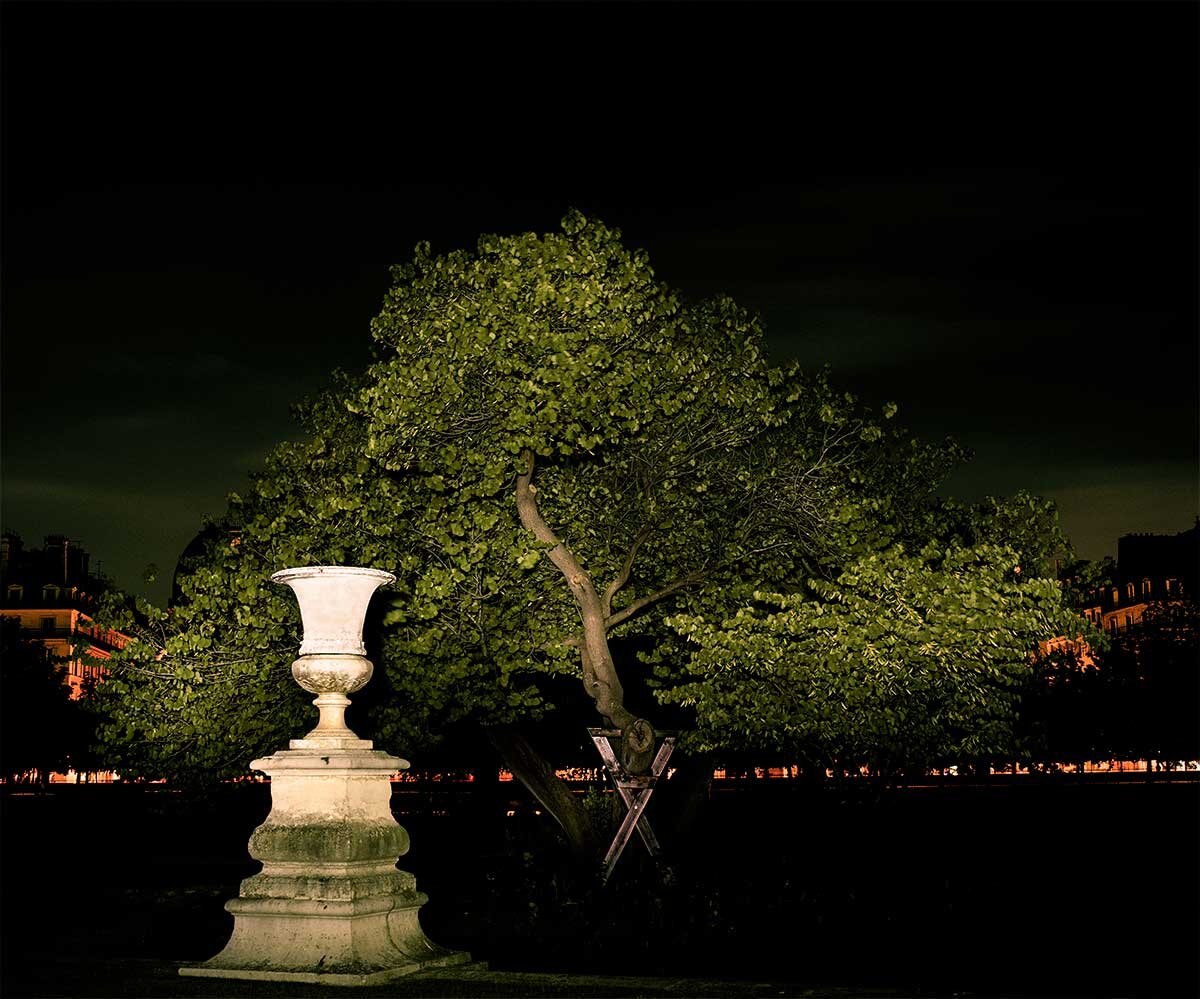
Thought to be introduced to France by the crusaders, the tree of Judea is native to the south of Europe and the west of Asia. This hermaphrodite tree, with a tortuous trunk, can measure up to 10 meters high. In April-May, before the leaves appear, it is covered with pink-purple flowers, grouped in small bouquets. The Jardin des Tuileries does not use any pesticides or insecticides, making this tree a magnet for bees who pollinate the flowers. The tree of Judea was formerly called the tree of Judas, because it is on this tree that, according to legend, Judas hung himself after betraying Jesus Christ.

Thought to be introduced to France by the crusaders, the tree of Judea is native to the south of Europe and the west of Asia. This hermaphrodite tree, with a tortuous trunk, can measure up to 10 meters high. In April-May, before the leaves appear, it is covered with pink-purple flowers, grouped in small bouquets. The Jardin des Tuileries does not use any pesticides or insecticides, making this tree a magnet for bees who pollinate the flowers. The tree of Judea was formerly called the tree of Judas, because it is on this tree that, according to legend, Judas hung himself after betraying Jesus Christ. The sculpture in the foreground is ‘Cain coming to kill his brother Abel’ by Henri Vidal. Marble. 1896

The Lebanon cedar was introduced in England around 1650 and the first specimens were brought from England and planted in France in 1734. They were given to Bernard de Jussieu, then Conservator of the Jardin des Plantes in Paris by P. Collinson. Legend has it that he brought back 2 cedars from England in his hat because he had broken their pots. One of them was planted in the labyrinth of the Jardin des Plantes (the tree in this photograph) and the other at Noissy-leRoi. This tree can reach 40 meters high in Europe and can live for 900 years.
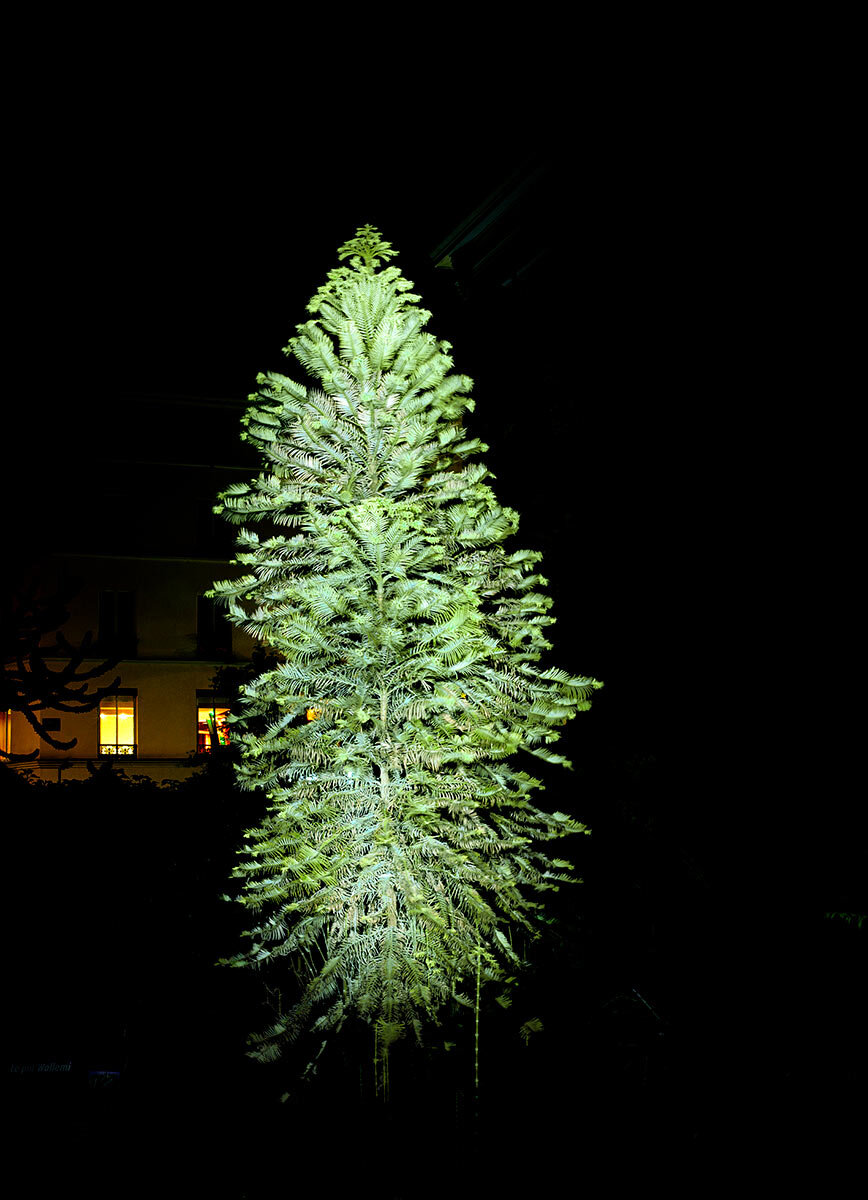
Related to araucarias and contemporary to dinosaurs, the Wollemi Pine was known only from fossils, until in 1994 an Australian forester found a growth in an isolated valley in the south east of Australia. The Australian government keeps this place secret and inaccessible and multiplies this tree to spread it around the world to reduce the risk of extinction. Thus, in 2006, three plants were offered to the Muséum National d’Histoire Naturelle in Paris. This Wollemi Pine grows proudly in front of the Gallery of Comparative Anatomy and Paleontology.
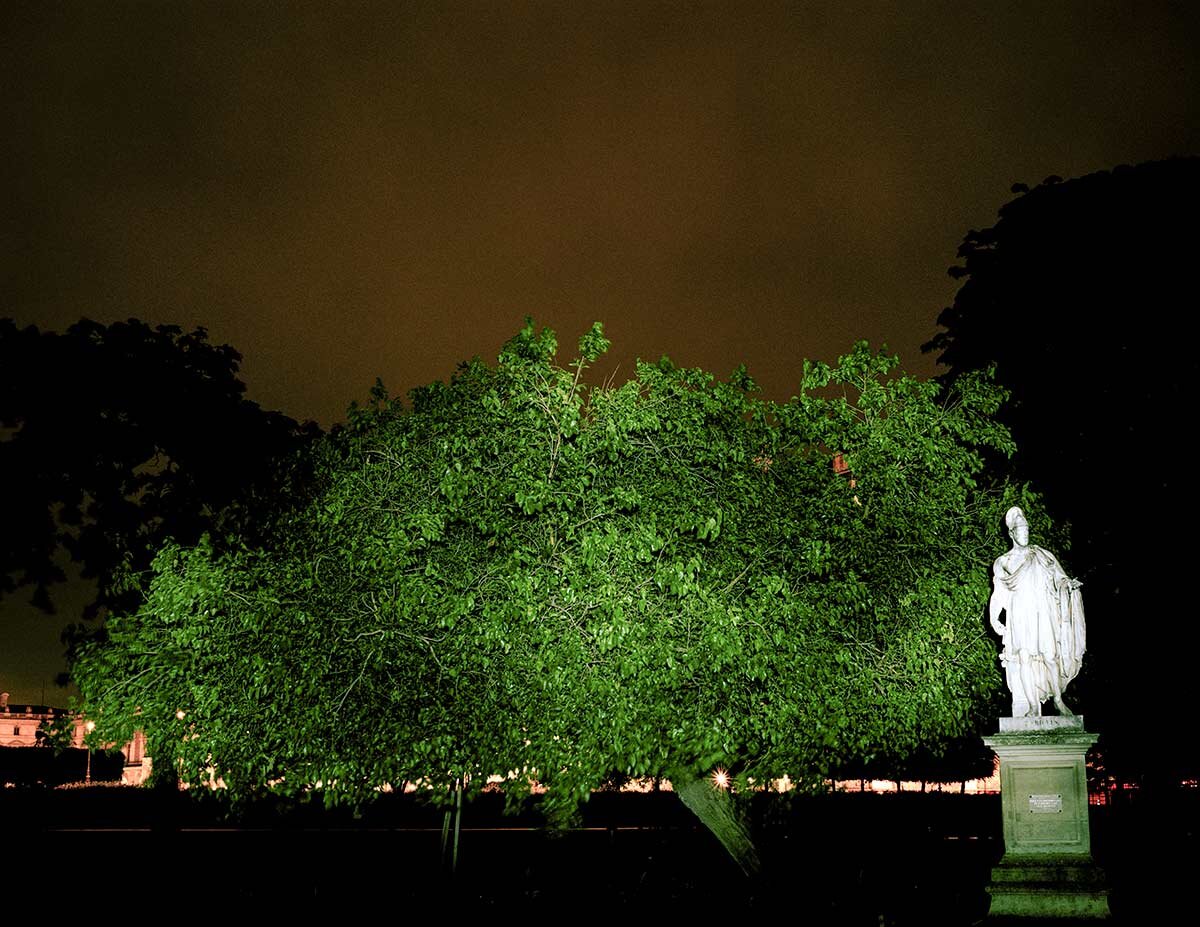
The Mûrier Blanc or White Mulberry tree originated in China and is a species found within the Moraceae family. The Tuileries Gardens were created for the widow of King Henri II, Catherine de Medici, but it was under King Henri IV reign, between 1589 and 1610 that mulberry trees were introduced to an area of the garden in the hope of cultivating silkworms. Sculpture in foreground, ‘Pericles distributing Wreaths to Artists’ by Jean-Baptiste Debay. Marble, 1833.
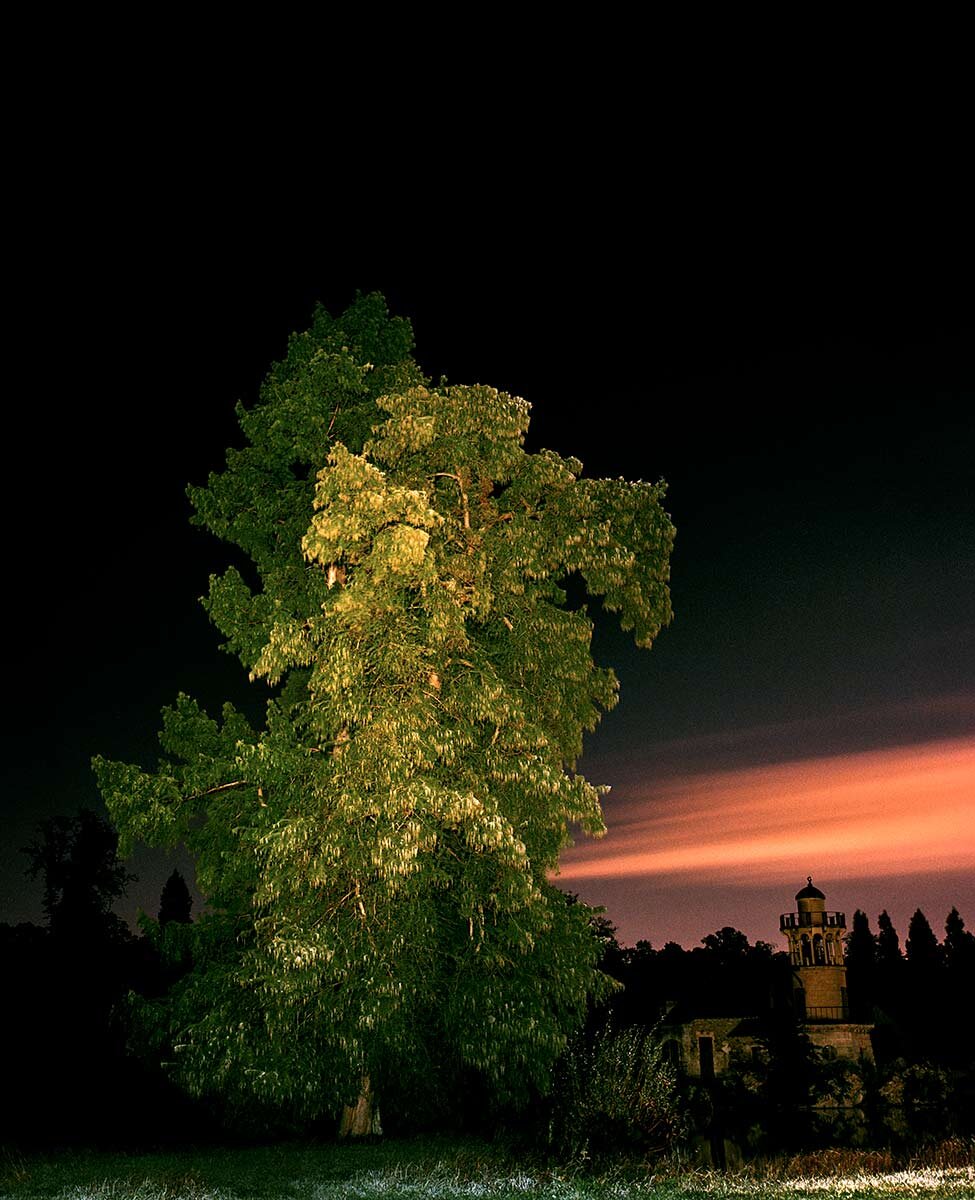
Originating from the east of the USA, this cypress tree was introduced in France in 1640. It was planted in parks at the end of the 18th century, at the water’s edge. Beautiful specimens adorn the Parc du Petit Trianon, Versailles (the tree in this image) and the Rambouillet park in France. This tree is situated on the edge of an artificial lake which formed part of the Hamlet of the Queen, a Norman style Hamlet especially built for Marie Antoinette from 1783 to 1785. In the background is the fishery tower or ‘Marlborough’ Tower.
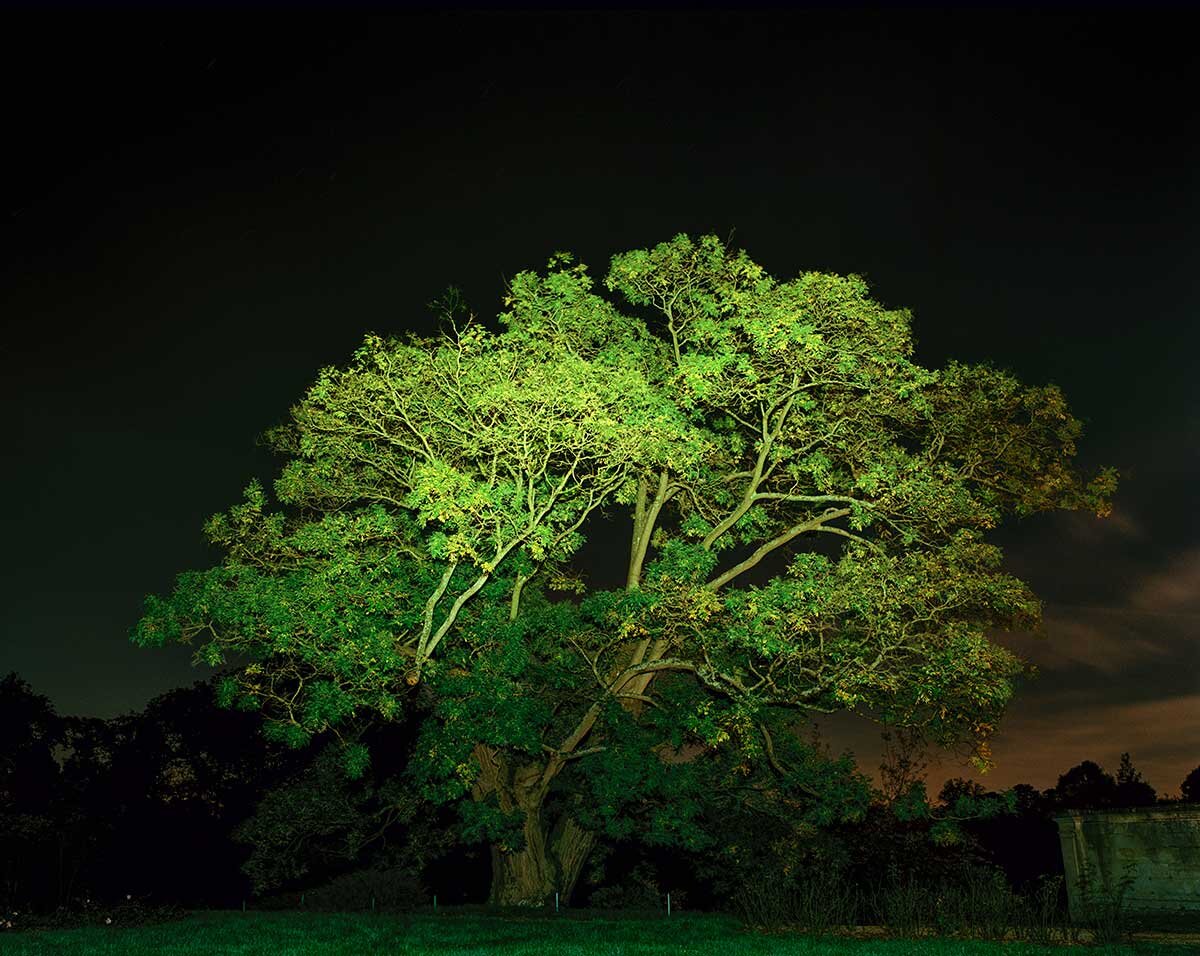
Also known as the Japanese Pagoda Tree. Grown from the seeds of the “unknown Chinese tree” of the botanical garden of Louis XV in Trianon which flowered in 1779, it was planted in April 1783 following the birth of the dauphin, son of Louis XV and Marie Antoinette. According to legend, Marie Antoinette specifically asked for this tree to be planted near her bedroom window to commemorate the birth of her son, so that she could watch it grow at the same time as her son

Originally from China, the Sophora of Japan was sent to Bernard de Jussieu in the form of seeds with the note “unknown Chinese tree” by a Jesuit naturalist who resided in China. It was planted in 1747 and flourished for the first time thirty years later.